Dan Padgett murders Nathan Oliver
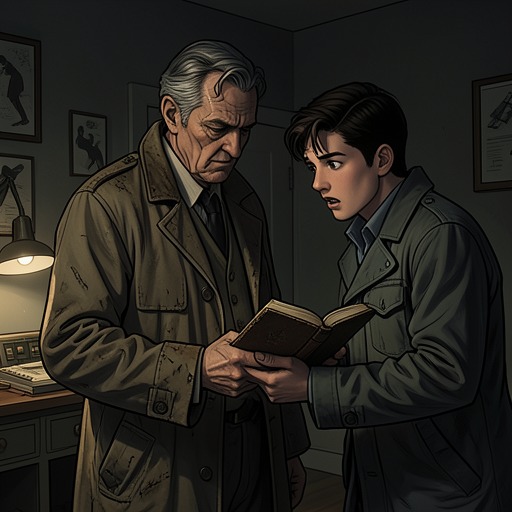
The LighthouseDan Padgett murders Nathan Oliver after discovering that Oliver is his father and confronting him at the lighthouse. The killing joins a concealed family history to a sudden, devastating refusal: Padgett seeks acknowledgment and financial provision, Oliver rejects both, and Padgett strangles him before trying to make the death look like suicide.
Background and Motive
Before her death, Martha Padgett confided to Adrian Boyde that Dan was Nathan Oliver’s son. She had entrusted the secret to Boyde, who had ministered to her and whom she and Mrs. Burbridge regarded as a priest; he was therefore bound by the seal of the confessional. Dalgliesh reasons that Boyde could not disclose what he had heard, but may have urged Martha to tell Dan herself. The secret’s revelation gives Padgett’s hatred of Oliver a new and intimate basis: the man he resented was not merely a famous island visitor, but his father.
Martha and Dan arrived on Combe Island in June 2003, after Oliver had publicly said in an April interview that he regularly visited the island. The interview broke the Trust’s agreement to keep information about Combe Island confidential and may have made a meeting between father and son possible. Dalgliesh considers whether Martha hoped that they would meet and that Oliver might acknowledge Dan. He also notes that DNA testing had not been available when Dan was born, while its later existence—and Martha’s awareness that she was dying—may have changed how she understood the possibility of proving his parentage. These circumstances help explain why the secret came to matter urgently, although Martha’s exact hopes and reasons for waiting remain conjectural.
The Confrontation and Killing
Dalgliesh reconstructs the killing as an impulsive confrontation rather than a planned murder. Evidence about Padgett obtaining hair leads him to infer that Padgett knew DNA testing required roots. The force with which the hair was pulled out, recalled by Mrs. Plunkett, suggests determination to obtain proof, while also fitting Dalgliesh’s account of a man carrying years of anger and humiliation. Padgett’s confidence about a different future may have reflected a hope that proof of his parentage would compel Oliver to acknowledge him and provide for him.
Padgett later described the confrontation to Kate Miskin. Oliver went up to the lighthouse lantern, and Padgett followed him there and told him his story. Oliver answered that he might have supported Padgett as a child but owed him nothing as a man, adding, “I owe you nothing and you’ll get nothing.” He dismissed Padgett as a contemptible blackmailer. Padgett then flew at him and fastened his hand around Oliver’s throat. The account supplies the immediate trigger: the hoped-for recognition was met not with uncertainty or negotiation but with rejection and contempt.
The Attempted Disguise and Its Significance
After strangling Oliver, Padgett tried to make the killing appear to be suicide. Dalgliesh’s reconstruction connects that failed disguise to the abruptness of the attack: Padgett may have seized what he saw as an opportunity to confront Oliver, then made a hapless attempt to conceal the violence once the confrontation ended in death. The murder thus combines accumulated grievance with a sudden act; the evidence supports neither a long-prepared plan nor a simple, motive-free outburst.
The killing also brings together the consequences of several silences. Martha had withheld Dan’s parentage for years; Boyde’s religious obligation prevented him from exposing her confidence; and Oliver’s public disclosure of his visits helped make a meeting possible. At the lighthouse, the truth finally reaches Oliver, but the acknowledgment Padgett seeks is refused. That refusal turns the discovery of kinship into the immediate cause of a second violent death, while the attempted staging cannot erase the confrontation that produced it.